Quick Answer
Yes — an active lime production line is a high-value, long-term industrial investment for operations in metallurgy, chemicals, and environmental treatment. With the right quicklime production plant configuration, operators consistently achieve strong output quality, lower per-ton costs over time, and a reliable supply of high-reactivity CaO for demanding applications like steelmaking desulfurization. The key is matching your system — whether a lime rotary kiln system or vertical shaft kiln — to your target capacity and raw material conditions.
Content
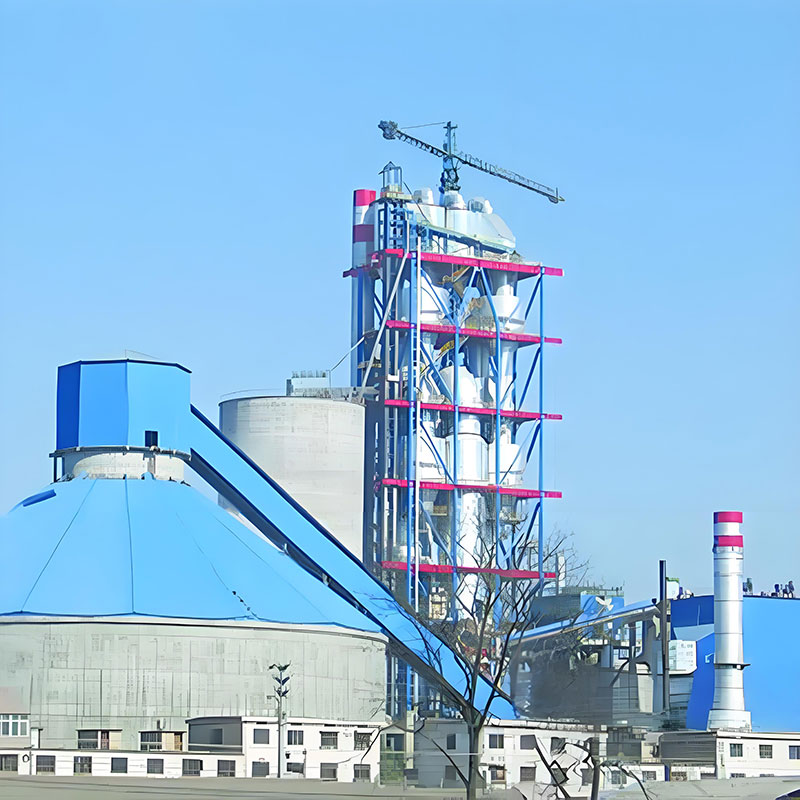
An active lime production line is a complete industrial system engineered to convert raw limestone (CaCO₃) into highly reactive calcium oxide (CaO) — commonly called quicklime — through a precisely controlled high-temperature calcination process. The system is designed not just for throughput, but for consistent, measurable lime activity, which directly determines performance in downstream applications.
The calcination reaction occurs at temperatures between 900°C and 1200°C. At this range, carbon dioxide is driven off and the resulting CaO retains a highly porous, reactive microstructure. The faster and more uniformly this is done — without over-burning — the higher the lime's reactivity index (typically measured in mL or t₆₀ values).
Limestone Crushing & Screening
Ensures consistent feed particle size (typically 20–80mm) for uniform calcination throughout the industrial lime calcination equipment.
Preheating System
Recovers waste heat from the kiln exhaust to preheat incoming limestone, reducing fuel consumption by 15–25% on modern systems.
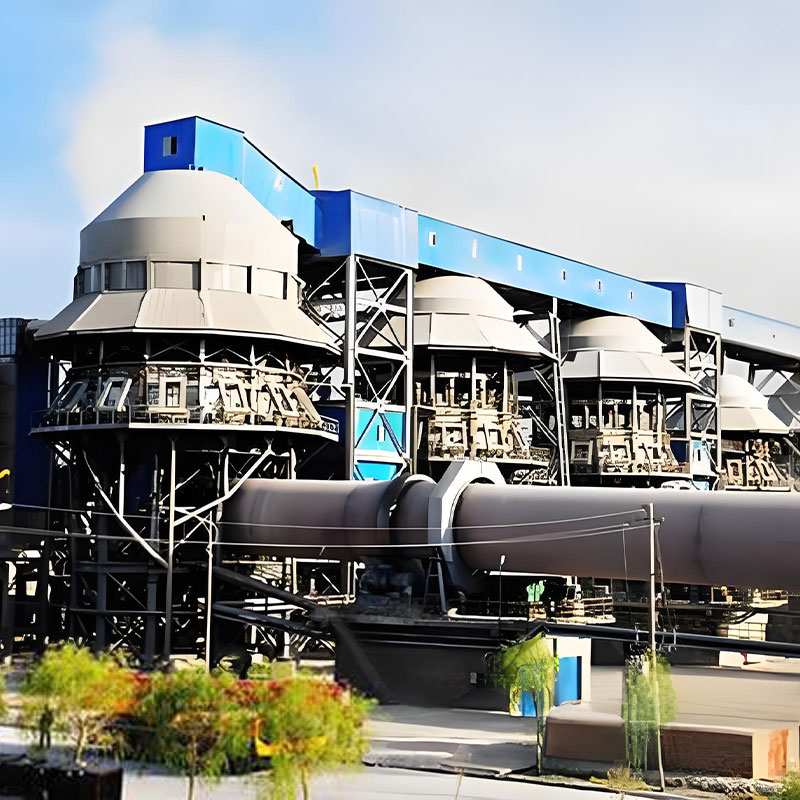
Lime Rotary Kiln / Vertical Shaft Kiln
The core calcination unit. Rotary kiln systems handle larger throughputs with higher uniformity; vertical shaft kilns offer lower energy consumption at moderate scales.
Cooling & Conveying
Rapid cooling preserves lime activity. Conveyor systems transport finished quicklime to storage or directly to hydrated lime processing lines.
Dust Collection & Gas Treatment
Bag filters and scrubbers manage particulates and SO₂ to meet environmental regulations — increasingly critical in all major markets.
Control & Automation Systems
PLC/SCADA integration enables real-time kiln temperature monitoring, fuel-air ratio adjustment, and production data logging for process optimization.
The term "active lime" is not just a marketing label. In industrial purchasing, lime is typically graded by its reactivity — measured as the volume of 4N HCl neutralized in 60 seconds (t₆₀ value). Lime from a high-efficiency lime kiln plant routinely achieves t₆₀ values above 300 mL, compared to standard lime at 150–200 mL. That gap translates directly to measurable downstream performance differences.
| Application | Lime Role | Impact of High Reactivity |
|---|---|---|
| Steelmaking (EAF/BOF) | Desulfurization flux | Reduces lime addition by 10–15%; improves S removal rate |
| Chemical Industry | Acid neutralization, Ca(OH)₂ production | Faster reaction kinetics, lower reagent waste |
| Wastewater Treatment | pH adjustment, precipitation | Reduces contact time; more consistent effluent quality |
| Flue Gas Desulfurization | SO₂ absorption via Ca(OH)₂ slurry | Higher SO₂ capture efficiency; lower operating cost |
| Construction & Infrastructure | Soil stabilization, mortar binder | Improved early strength development |
In steelmaking alone, active lime is not optional — it is a standard auxiliary raw material in most electric arc and basic oxygen furnace operations. Studies from major steelmaking regions show that switching from standard lime to active lime (reactivity >300 mL) can reduce lime consumption per ton of steel by 12–18%, directly cutting raw material costs and improving slag formation efficiency.
Choosing the right kiln type is one of the most consequential decisions in planning a quicklime production plant. Both the lime rotary kiln system and the vertical shaft kiln can produce active lime — but they differ significantly in scale, energy profile, investment level, and operational flexibility.
Lime Kiln System Comparison — Key Performance Indicators
Daily Output Capacity (tons/day)
Lime Reactivity Consistency (relative score)
Energy Efficiency (relative score, higher = more efficient)
When to Choose a Lime Rotary Kiln System
Best for operations requiring output above 300 t/d, mixed or finely crushed limestone feed, and applications demanding highly consistent reactivity — such as steelmaking or large-scale flue gas treatment. The rotary kiln's continuous rotation ensures even heat exposure and avoids dead zones that lower reactivity uniformity.
When a Vertical Shaft Kiln Makes More Sense
If your target capacity is below 200–300 t/d, limestone quality is consistent, and your priority is lower initial investment and reduced fuel cost per ton, a modern double-chamber or annular shaft kiln can deliver good activity levels with substantially lower capital expenditure.
Understanding the financial case for a complete active lime production line requires looking beyond the purchase price of the industrial lime calcination equipment. The real ROI picture emerges from three interconnected factors: input cost control, output quality premiums, and operational longevity.
Cumulative Cost Savings vs Self-Production (Illustrative, USD/ton-year basis)
Many operators who commission a quicklime production plant eventually expand into hydrated lime (calcium hydroxide) production. The hydration process is simple in principle — controlled water addition to hot quicklime — but the equipment configuration significantly affects product quality, moisture content, and specific surface area.
A well-designed hydrated lime processing line typically includes a hydrator (forced-agitation or drum type), classifier, and packaging system. The output can serve multiple additional markets: drinking water treatment, paper manufacturing, food-grade applications (where purity is certified), and agriculture. This diversification significantly reduces reliance on a single customer segment.
Practical Note on Integration
Connecting a hydrated lime processing line to an existing active lime production line requires careful heat management — the hydration reaction is exothermic and generates steam. Proper ventilation and moisture-control systems must be factored into plant layout from the design stage, not retrofitted after commissioning.
Before finalizing any procurement decision on industrial lime calcination equipment, operators should conduct a structured feasibility assessment covering the following dimensions:
Jiangsu Haijian Co., Ltd was established in 1970 and reorganized as a provincial privately-owned joint-stock company in 2003. Over more than five decades, the company has grown into one of China's primary manufacturing enterprises for cement production equipment, industrial solid waste incineration systems, and professional equipment for mining and metallurgical applications — including complete active lime production lines.
The company employs over 300 personnel, with engineering and technical staff comprising 25% of the total workforce. Its manufacturing campus covers 100,000 m² of total area with 55,000 m² of built production space — supporting a full range of heavy industrial fabrication capabilities.
Vertical Lathes
Φ2.5–10m diameter range
Gear Hobbing Machines
Φ2–8m capacity
Floor-Type Lathes
Φ5×16m and Φ7×20m
Overhead Cranes
10–150t lifting capacity
Gas Annealing Furnaces
6.5×6.5×18m chambers
Total Equipment
500+ units/sets across all categories
Jiangsu Haijian holds independent import and export rights and is legally authorized to undertake general contracting for foreign projects. The company serves as a key backbone enterprise and primary export base for cement, power, environmental protection, and metallurgical and mining equipment in China — making it a reliable partner for international buyers evaluating active lime production line investments.
Even experienced procurement teams make avoidable errors when commissioning lime production systems. These are the issues that consistently emerge in post-installation reviews:
Over-specifying capacity without demand alignment
Selecting a 1,000 t/d lime rotary kiln when actual offtake is 400 t/d means running at 40% load — which increases fuel cost per ton and accelerates refractory wear unevenly. Size to 110–120% of confirmed demand, not theoretical maximum.
Neglecting limestone particle size distribution
Feed material with a wide particle size range (e.g., 10–100mm) causes uneven calcination — smaller pieces over-burn while larger ones remain partially uncalcined. A proper crushing and screening circuit is not optional; it directly determines lime reactivity consistency.
Underinvesting in automation and instrumentation
Manual kiln operation introduces temperature variability of ±50°C or more. Even a basic PLC-based control system with thermocouple feedback across multiple kiln zones reduces reactivity variance significantly and cuts fuel waste.
Treating dust collection as an afterthought
Bag filter systems sized for initial regulatory compliance may not accommodate future tightening of emission standards. Build in 20–30% headroom on filter capacity at the specification stage; retrofitting is far more costly than designing correctly from the start.
Q1: What is the minimum production volume that makes an active lime production line economically viable?
Generally, a minimum capacity of 100–150 t/d is considered the threshold where in-house lime production becomes more cost-effective than purchasing on the market, assuming stable limestone supply and consistent downstream demand. Below this level, a vertical shaft kiln or mobile calcination unit may be a more practical starting point.
Q2: How long does it take to commission a complete lime rotary kiln system?
A typical lime rotary kiln system project — from equipment delivery to stable full-load operation — takes 6 to 14 months depending on site preparation complexity, kiln diameter, and civil construction timelines. Smaller shaft kiln systems can be commissioned in 4–8 months. Detailed engineering and procurement should begin 6–9 months before targeted commissioning date.
Q3: What limestone CaO content is required for high-quality active lime production?
Limestone with a CaO content of 54% or above is recommended for active lime production targeting metallurgical-grade applications. Lower CaO content (50–53%) can still be used but will result in higher impurity levels in the finished lime, which may not meet specifications for steelmaking desulfurization or food/pharmaceutical applications.
Q4: Can an existing cement kiln be converted to a lime rotary kiln system?
In some cases, yes — but it requires significant modifications to the kiln's temperature zone profile, refractory lining specification, and cooling system. Lime calcination operates at lower peak temperatures than clinker formation (~950–1100°C vs 1450°C), but the process requires more precise temperature uniformity. An engineering feasibility study is essential before attempting any such conversion.
Q5: What is the typical fuel consumption of modern industrial lime calcination equipment?
Modern high efficiency lime kiln plants equipped with preheater towers achieve thermal consumption of 850–1,050 kcal/kg of lime. Older or less optimized systems may consume 1,300–1,600 kcal/kg. The difference is substantial: at 500 t/d production, a 300 kcal/kg improvement in efficiency translates to roughly 150 GJ/day in energy savings — a significant operational cost reduction over time.
Q6: Is a hydrated lime processing line difficult to add after the quicklime production plant is already running?
Adding hydration capacity after initial commissioning is technically feasible but more costly than planning for it from the start. Space allocation, conveying routes from the cooler to the hydrator, and steam ventilation all need to be integrated into the plant layout. If hydrated lime is even a possibility in your business plan, reserve the space and conveyance infrastructure during the original plant design phase.
It is focused on the overall solution of dry bulk material port transfer system,
research and development, manufacturing, and service